
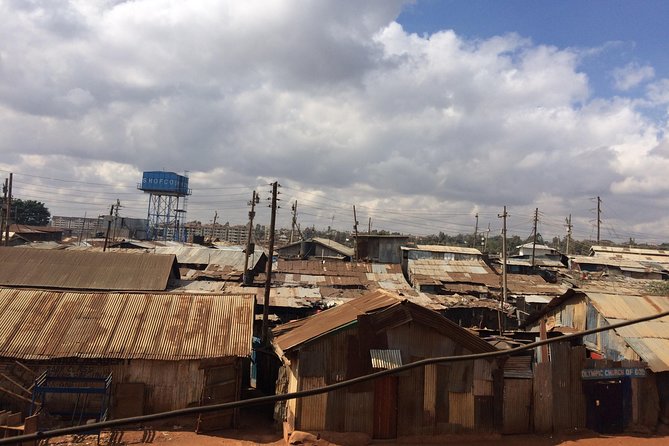
Reviewed · KIBERA SLUM TOURS
Kevins Kibera Slum Tours
Kibera is not a museum exhibit. It is a working neighborhood where people study, shop, raise families, make a living, and build community in very hard conditions. This private tour takes you there with Kevin or his brother Ismael, both local guides with personal ties to the area.
I like the local perspective and the chance to visit Kevin’s family home, rather than simply walking past rows of buildings. I also like the range of stops, from a school and orphanage to a bone workshop, marketplace, landfill, and train track. The main caution is the footing: paths can be uneven, muddy, and precarious, especially after rain.
Key points to know before booking

- Born-and-raised Kibera guides: Kevin and his brother Ismael bring personal stories and strong community connections.
- A private four-hour visit: Only your group takes part, making it easier to ask questions and move at a comfortable pace.
- More than a street walk: The route includes a school, family homes, a bone workshop, a bag-making project mentioned during the tour, the market, landfill, and train track.
- Hotel pickup is included: The scheduled start is 8:00 am, with front-door pickup and drop-off from hotel accommodation in Nairobi.
- Wear shoes for mud and rough ground: Close-toed shoes that can get very dirty are the practical choice.
- A serious, human subject: You will see poverty and poor infrastructure, but also family life, work, education, kindness, and local effort.
Entering Kibera with Kevin or Ismael

The strongest part of this tour is the guide. Kevin grew up in Kibera, and Ismael, his brother, also lives there and remains closely involved with the community. That changes the visit from a distant look at poverty into a personal walk through someone’s home area.
You are not simply handed a list of facts. You can ask how people live, where children study, how families earn money, and what local projects are trying to improve. Ismael is often the guide, while Kevin leads some departures. Both are described as warm, hospitable, and well connected in the neighborhood.
That connection matters for practical reasons. Several people who took the tour felt safe walking with Ismael or Kevin because residents knew them and welcomed their presence. You should still behave with care. Kibera is a home, not a backdrop. Ask before taking photographs, keep your clothing and manner respectful, and listen more than you perform.
The tour is private, so your group does not have to share the outing with strangers. That gives you room to pause at a school, ask a sensitive question, or decide how much time you want to spend talking with the guide. It also makes the $65 price easier to assess. For a solo visitor, it is not the cheapest Nairobi activity, but it includes a private guide and hotel transfers. For a couple or family, the cost buys a focused half-day with fewer logistical worries.
More guided Kibera walks:
- Nairobi: Explore Kibera Slum with Local Guides
★ 4.9 · 365 reviews - Nairobi: Kibera Slum storytelling tour with a Local
★ 5.0 · 185 reviews - Kibera Slum Tour with Lucas
★ 5.0 · 119 reviews
The first stops: school, orphanage, and local education
The school and orphanage are among the most affecting parts of the visit. You get a look at how children study in a community where space, money, clean water, toilets, and other basic services can be limited.
The point is not simply to feel sorry for the children. The more useful lesson is to see the work being done by local people who create schools and support programs with little funding. Some projects focus on helping promising students continue their education, including opportunities outside Kibera.
This can be difficult to process. You may see children playing near broken surfaces, exposed hazards, or makeshift structures. At the same time, you will see ordinary childhood: jokes, curiosity, smiles, and friendships. The contrast is what makes this stop powerful, but it can also make the visit emotionally heavy.
If you are traveling with children, the tour has been suitable for families, including children around eight and nine years old. Still, talk with your children beforehand about poverty, privacy, and respectful behavior. This is not a light sightseeing stop, and a thoughtful conversation will help them understand what they are seeing.
Visiting Kevin’s house and his family
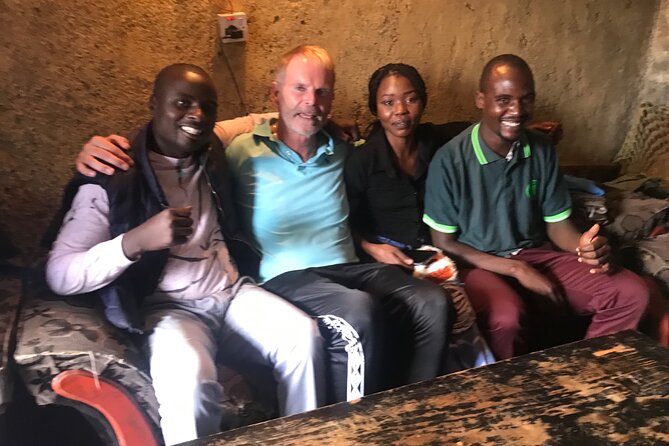
A personal home visit gives the tour its clearest human scale. Instead of viewing Kibera only from the path, you get an invitation into the guide’s family world. You may meet members of Kevin’s or Ismael’s family and see the ordinary domestic side of a place often reduced to a headline.
This is where the tour can correct easy assumptions. A family home is not just a symbol of hardship. It is also a place where people laugh, argue, welcome visitors, and get on with daily life. That ordinary contact is one of the most valuable parts of the outing.
You should treat the invitation as a privilege, not an entitlement. Follow your guide’s lead, do not wander into private areas, and ask before photographing anyone. A small gesture of courtesy matters more here than trying to capture a dramatic image.
The visit also helps explain why local guides can offer something a guide from outside the area cannot. Kevin and Ismael are not describing a neighborhood from a distance. They are introducing you to a place tied to their family, childhood, work, and ongoing community life.
Bone workshop and community work

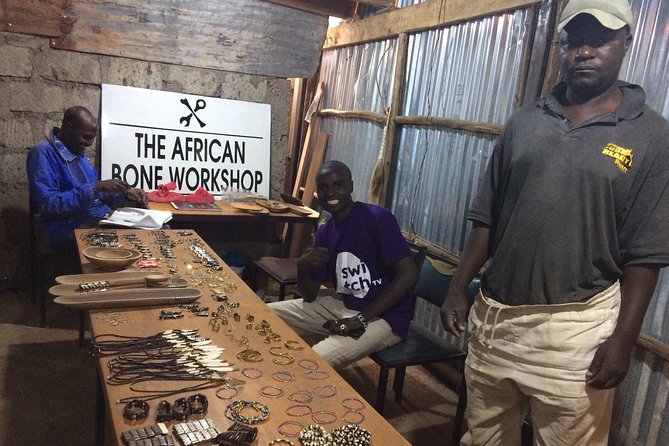
The African bone workshop adds an important economic angle. Here you can see a local craft business turning discarded cow bone into jewelry or other products. The stop shows practical skill and resourcefulness, not just deprivation.
A community empowerment bag-making company may also be included, depending on the route and timing. This gives you another example of people trying to create income and build useful work within Kibera. If you are interested in buying a small craft item, ask your guide how purchases support the makers and what payment methods are available. Food and drinks are not included, and no shopping allowance is specified, so bring only what you are comfortable carrying.
These stops help balance the harder scenes. Kibera is poor, but it is not without enterprise. People make things, sell goods, teach children, care for family, and organize projects. The visit becomes more honest when you see both the limits and the effort.
A few more Nairobi days to weigh up
- Nairobi National Park Half-Day Tour; Free Wi-Fi connection
★ 5.0 · 878 reviews - Nairobi: National Park & Optional Elephants & Giraffe Center
★ 4.8 · 874 reviews - NAI NAMI: Nairobi Storytelling Tour with Street Children
★ 5.0 · 792 reviews - Nairobi National Park Half-Day Game Drive
★ 4.5 · 738 reviews
The landfill, train track, and main street market

The later walk brings you through some of Kibera’s most difficult physical conditions. The landfill illustrates the problems created by waste collection and limited infrastructure. The train track and main street market show how people move, trade, and use available space in a dense urban settlement.
These are not polished attractions. Conditions can be dirty, crowded, and uncomfortable. You may need to step carefully and follow closely behind your guide. The walk is not a smooth sidewalk stroll, and rain can make the route much harder.
The market is useful because it shows the everyday business of the neighborhood. People shop for necessities, vendors work, and residents move through the area as they would in any other part of Nairobi. The setting is far rougher than most visitors are used to, but the activity is normal local life rather than a performance arranged for a tour.
At several points, children and residents may notice your group. The guide’s local relationships help, but your own conduct still matters. Avoid turning people into photographs or treating poverty as entertainment. A good visit stays curious, restrained, and human.
What the four-hour schedule feels like
The advertised duration is about four hours, while the Kibera portion is listed at roughly three hours. The remaining time is useful for hotel pickup, drop-off, and moving into and out of the neighborhood.
The start time is 8:00 am. An early departure gives you a clear morning block and leaves room for other Nairobi plans later in the day. Allow some flexibility, though. One person reported a pickup arriving about an hour later than expected, so confirm the pickup details after booking and avoid scheduling a tight connection immediately afterward.
Because the tour is private, the pace can be more personal than on a large group outing. You can ask questions as you go and spend more time at a family home or school if the situation allows. The exact order of stops may vary, since local conditions and the guide’s judgment shape the route.
Pickup and drop-off from hotel accommodation in Nairobi are included. The information provided specifies hotels, so confirm the arrangement if you are staying somewhere else. A mobile ticket is provided, and booking confirmation arrives at the time of booking.
Is $65 a fair price?
At $65 per person, this is best judged as a private guided visit rather than a cheap neighborhood walk. You are paying for a local guide, a prepared route, personal introductions, and round-trip hotel transfers. Those elements remove much of the uncertainty that comes with trying to enter and navigate Kibera on your own.
The value is strongest for a first visit to Nairobi, a solo visitor who wants a guide nearby, or a small family that needs a focused schedule. It is also useful if you care about meeting local people and understanding community projects, not just checking off a sight.
The price does not include food or drinks. No meal is part of the outing, so eat beforehand and carry water if you need it. The tour also does not promise a donation, craft purchase, or other contribution beyond the booking itself. If you want to give back, ask Kevin or Ismael which local project can receive useful support. Do not hand out money or sweets to children without guidance.
With a 98 percent recommendation rate and a 4.9 rating from 213 ratings, the experience has a strong record. Those numbers do not remove the need to prepare, but they support the idea that the guide quality and personal contact are the main strengths.
Safety, clothing, and physical effort

The main practical issue is walking. The ground can be uneven, narrow, muddy, and slippery. After rain, some sections may become especially precarious. You need reasonable balance and the ability to walk over rough surfaces for an extended period.
Wear close-toed shoes that you do not mind getting dirty. Leave delicate footwear, open sandals, and anything you cannot clean at home behind. Comfortable clothing is sensible, and you should carry only what you need.
Most people can participate, but the tour is not a good match for anyone with serious balance or walking problems. Older visitors should consider the conditions carefully. The private format may help with pacing, but it cannot turn rough paths into paved ones.
Several solo women felt comfortable with Ismael as their guide. That is encouraging, but standard city awareness still applies. Keep valuables secure, stay with the guide, and follow his instructions around crowded or difficult sections.
Good weather is required. If poor weather forces cancellation, you can choose another date or receive a full refund. You can cancel for a full refund up to 24 hours before the start time. Changes or cancellations inside that 24-hour window are not accepted for a refund.
The ethical question: seeing hardship without making a spectacle
A Kibera tour raises a fair question: is it right to visit a poor neighborhood as a sightseeing activity? The answer depends largely on how the visit is organized and how you behave during it.
This tour is led by people raised in Kibera, includes family and community connections, and directs attention toward schools, crafts, work, and local projects as well as hardship. That is a better starting point than a detached drive-by view.
Still, no guide can erase the power difference between a paying visitor and someone living with fewer resources. You should not expect residents to entertain you, and you should not assume that every person wants to be photographed. Listen to your guide, ask permission, and remember that the most meaningful part of the visit may be a conversation rather than a picture.
I also recommend leaving room for mixed feelings. You may feel inspired by local strength, frustrated by government neglect, and uncomfortable with your own good fortune. Those reactions are not a problem to solve during the walk. They are part of understanding the place honestly.
Who should book Kevin’s Kibera Slum Tours?
Book it if you want a personal introduction to Nairobi through someone who lives the story. The tour suits curious adults, respectful solo visitors, couples, and families with older children who can handle a serious subject and rough walking.
It is especially worthwhile if you want to visit a school, meet a local family, see small businesses, and understand how community efforts operate. The private format and hotel transfers make it a practical choice during a short Nairobi stay.
Think twice if you dislike walking on uneven ground, need guaranteed punctual pickup, or want a light, polished attraction. Kibera is intense, dirty in places, and emotionally demanding. It will not leave you with a simple feel-good story.
Should you book it?
I would book this tour if you want to understand Nairobi beyond its parks and major sights. Kevin and Ismael give the visit a human connection, and the combination of school, home, workshop, market, landfill, and train track creates a fuller picture than a quick look from a vehicle.
Wear sturdy shoes, confirm your pickup, keep your expectations respectful, and leave extra time after the tour. If you can do that, the $65 fee is reasonable for a private, locally led half-day that may change how you see the city and the people who call Kibera home.
FAQ
Where does Kevin’s Kibera Slum Tour take place?
The tour takes place in Kibera, Nairobi, Kenya.
How long does the tour last?
The full experience lasts about four hours. The Kibera portion is listed as about three hours.
What time does the tour start?
The scheduled start time is 8:00 am.
Is hotel pickup included?
Yes. Round-trip pickup and drop-off are offered from hotel accommodation in Nairobi.
Is this a private tour?
Yes. Only your group takes part in the activity.
Who leads the tour?
The tour is led by Kevin or his brother Ismael, both of whom were raised in Kibera. The supplied information identifies Ismael as a frequent guide.
What places will I see?
The route includes an African bone workshop, an orphanage school, Kevin’s house and family, a landfill, a train track, and the main street market. Some descriptions also mention a community bag-making company.
Is food included?
No. Food and drinks are not included.
What should I wear?
Wear close-toed shoes that you do not mind getting very dirty. The walking route can be uneven and precarious, especially after rain.
Can I cancel for a full refund?
Yes. You can cancel at least 24 hours before the local start time for a full refund. Cancellations or changes made less than 24 hours before the start are not refunded or accepted.
What happens if bad weather cancels the tour?
If poor weather causes cancellation, you will be offered another date or a full refund.
Just added around Nairobi
- Visit kibera Slum the chocolate city★ 4.8 · 3 reviews
- 4 Days Safari to Lake Nakuru N/P and Maasai Mara N/R★ 5.0 · 18 reviews
- Maasai Mara Day Trip★ 5.0 · 15 reviews
- 4 Days Tour Landcruiser in Masai Mara and Lake Nakuru★ 5.0 · 10 reviews
- 3 days maasai mara migration safari★ 4.5 · 7 reviews
- Kibera Slum Tour with a Local★ 5.0 · 15 reviews
- Wildebeest Migration in Masai Mara and Sightseeing 4 Days Tour★ 4.5 · 6 reviews
- Day Tour to Nairobi national park, Elephants, and Giraffe Center★ 3.5 · 8 reviews
Kibera Slum Tours, compared.




Kibera Slum Tour with Local Social Entrepreneurs
Read our review →



Browse the lists this tour appears in